Here is the comprehensive, data-driven update on the surging U.S. oil export market, the collapse of cartel unity, and the geopolitical catalysts driving today’s trading action as of Thursday, April 30, 2026.


By George Magazine
Here is the comprehensive, data-driven update on the surging U.S. oil export market, the collapse of cartel unity, and the geopolitical catalysts driving today’s trading action as of Thursday, April 30, 2026.
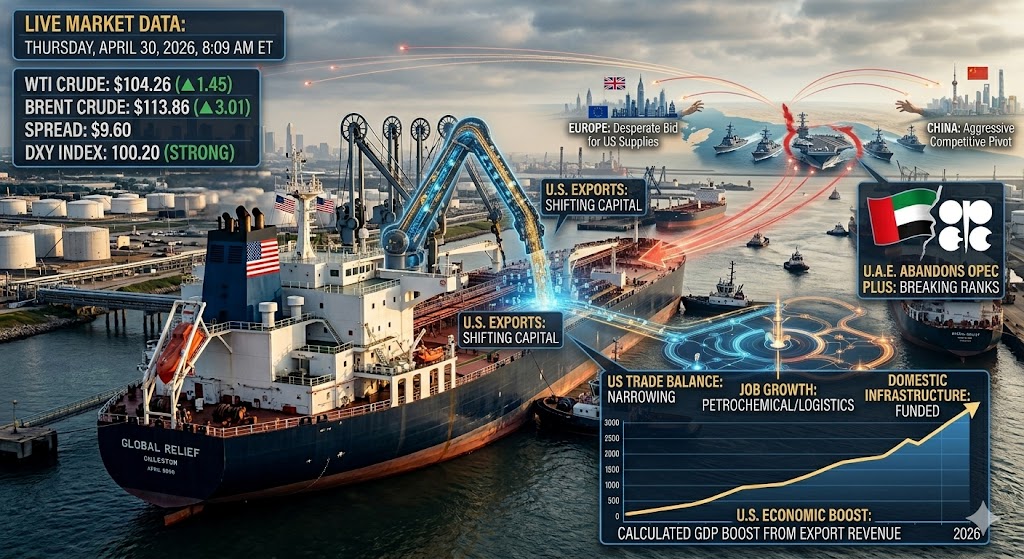
Market Data Snapshot
Behind the Scenes: The Hormuz Chokehold
The U.S. Navy’s active blockade of the Strait of Hormuz remains the absolute focal point of global energy markets. With the ongoing war with Iran, Operation Epic Fury has effectively landlocked the Middle East’s primary export routes. This ongoing military action traps roughly 20 percent of global daily consumption. The Middle East has temporarily transitioned from the world’s most reliable supplier to a massive stranded asset, completely upending global energy logistics.
The U.A.E. OPEC Exit: A Shattered Cartel
The ripple effects of the United Arab Emirates officially pulling out of OPEC and the broader OPEC Plus alliance are tearing through the markets. The U.A.E. is no longer willing to leave billions of dollars on the table and is breaking ranks to pump at maximum capacity. However, this creates a fascinating paradox. The U.A.E. wants to capture market share, but they still have to navigate the logistical nightmare of the Persian Gulf blockade to actually get those barrels to buyers. The real market impact is psychological: OPEC has functionally lost its ability to dictate global pricing, transferring total market control to the Western Hemisphere.
America: The Undisputed Swing Producer
With Middle Eastern crude effectively offline, the global energy map has rapidly shifted entirely to the United States.
The U.S. Economic Windfall
This dramatic surge in exports is an asymmetrical macroeconomic weapon for the United States. While rival nations bleed capital to secure energy, the U.S. is raking in record export revenues. This capital influx rapidly narrows the trade deficit and funds a massive expansion in domestic energy infrastructure. By controlling the full chain from production to consumption, U.S. energy producers are gaining significant cost advantages over global competitors.
The Dollar and Other Markets
The DXY is flexing massive strength at 100.20. Global buyers are suffering a double tax. They must pay historic premiums for physical crude, and they must purchase expensive U.S. dollars to execute the transactions. Standard market correlation dictates that a strong dollar suppresses commodity prices. That rule is currently suspended because physical scarcity is completely overriding currency headwinds. Other oil markets, including refined products like diesel and aviation fuel, are seeing extreme backwardation as immediate physical delivery becomes the only metric that matters.
What to Expect in Today’s Trading
Expect a highly erratic session focused on two conflicting narratives.
Blind Spots Analysis:
*****
Get Ageless Tech. Using AI to Your Advantage: https://georgemagazine.com/agelesstech/
Get George’s America’s 250th: https://georgemagazine.com/product/america-250-celebrating-legacy/
Get The George Dispatch: https://georgemagazine.com/thedispatch/
Get George Magazine. Print or Digital: https://georgemagazine.com/subscribe-george-magazine/
Get George Junior. Print or Digital: https://georgemagazine.com/subscribe-george-junior-magazine/
Get George’s Crypto E-Playbook: https://georgemagazine.com/product/the-crypto-playbook-by-george-magazine/


Subscribe to George Magazine and unlock exclusive bonuses. Your subscription now includes a free crypto essentials guide and three premium downloadable images. These images are perfect for personal use as desktop or mobile backgrounds, with thumbnail previews shown below.
![Enjoy the [Road] Show Travel Mug with Handle, 14ozEnjoy the [Road] Show Travel Mug with Handle, 14oz](https://georgemagazine.com/wp-content/uploads/2024/08/479070202831754764_2048-300x300.jpeg)

Discount Applied Successfully!
Your savings have been added to the cart.