

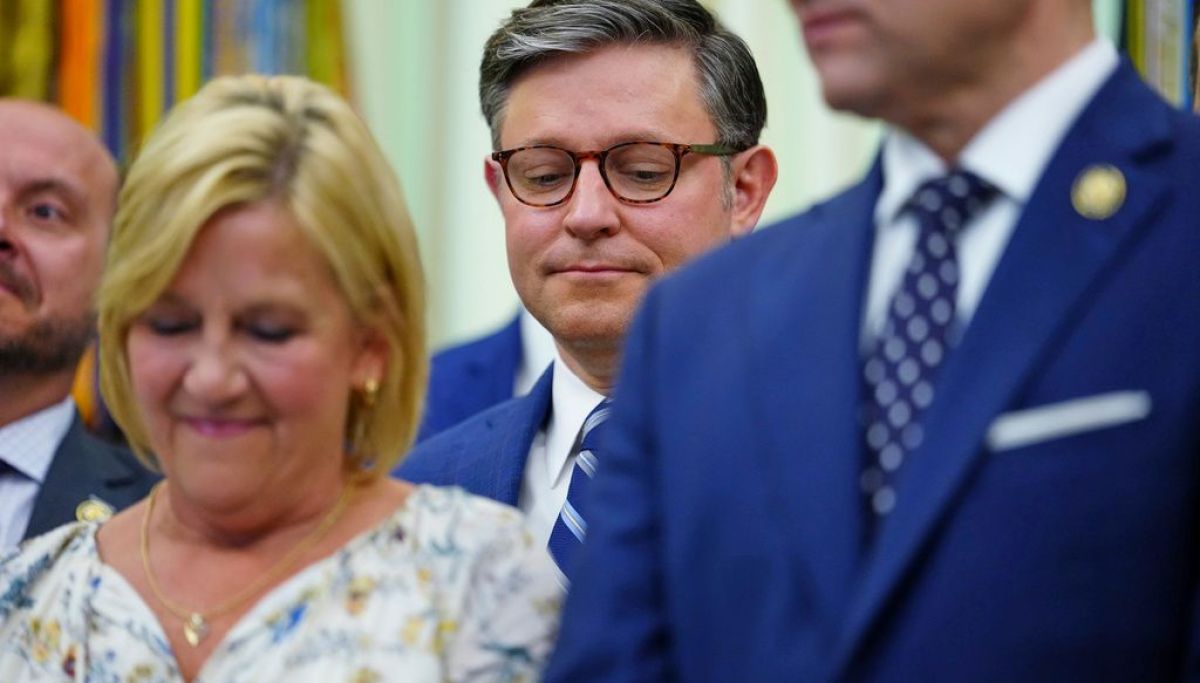
A bitter fight over the federal government’s spy powers is quickly becoming a test of how much sway House Speaker Mike Johnson (R-LA) has with President Donald Trump.
Johnson, a close ally who owes his speakership to Trump’s vote of confidence, has traveled to the White House twice this week to resolve a dispute over Section 702 of the Foreign Intelligence Surveillance Act. The authority, which allows foreign surveillance without a warrant, was on track to pass the Senate, but the deal fell apart last week when Democrats objected to Trump appointing Bill Pulte as his interim intelligence chief.
Johnson’s outreach has so far failed to break the impasse. Congress is at risk of letting Section 702 expire on Friday, and if anything, the president has doubled down on Pulte, moving up the start date of his appointment to next week. But Democrats plan to withhold the votes to pass an extension until the president gives some sort of concession, viewing Pulte as inadequate given his lack of national security experience.
On Wednesday, Sen. Mark Warner (D-VA), the top Democrat on the Intelligence Committee, said he would support an extension if Trump replaced Pulte with deputy intelligence chief Aaron Lukas.
Trump lavished Johnson with praise on Wednesday when he attended a bill signing at the White House.
“I want to thank Speaker Mike Johnson, he’s incredible,” Trump said. “Mike, you’re doing an incredible job, and not a big majority.”
Trump appears unmoved by Johnson’s meetings, however, and is reportedly not convinced Republicans should meet Democrats’ FISA demands. On Wednesday morning, the president sent a Truth Social post noting that he’s looking for a “permanent ODNI Nominee with experience in National Security” and urged Congress to back a short-term extension of FISA in the meantime.
Democrats, for their part, are unwilling to budge — even for a brief patch lasting into early July. Instead, Johnson is barreling toward a Thursday vote to extend the Section 702 authority and hoping that some compromise can be worked out, or that Democrats will back down in the face of Republican pressure.
Senate Majority Leader John Thune (R-SD) has been letting Johnson take the lead on advising Trump. His relationship with the president has become rockier over the SAVE America Act and tactical disagreements on the campaign trail, butut even before then, Thune has not gone to the same lengths as Johnson to ingratiate himself with Trump.
Thune spoke with the president last week, but not about FISA, and declined an invitation from the White House to attend the bill signing on Wednesday. It’s not unusual for Thune to be represented at White House events by Senate Majority Whip John Barrasso (R-WY), who attended in his place.
Trump, a real estate mogul and former reality TV star, could not be more different in style compared to Johnson, a clean-cut and deeply religious Southern Baptist.
But since Trump’s return to the White House last year, the pair have been able to keep Republicans unified in the House despite their narrow majority. Johnson speaks with the president more frequently than Thune and leans on him more often to end disputes from rebellious members of his conference.
“It’s the best relationship between a president and a speaker since Denny Hastert and George W. Bush,” John Feehery, the onetime press secretary to former House Speaker Dennis Hastert, told the Washington Examiner. “The president relies on the speaker to move his agenda, and the speaker relies on the president to get him the votes. It is a totally symbiotic relationship. They are joined at the hip and necessarily so.”
Thune, by contrast, earned his role as majority leader in 2024 without the president’s help, and though he has aligned himself with the president on most issues, Thune is more willing to say “no” to Trump when Senate Republicans lack the votes to advance some of his demands.
Rep. Lisa McClain (R-MI), who, as a member of House leadership, is familiar with Johnson’s relationship with Trump, dismissed the idea that Johnson is simply a “yes-man” to Trump and suggested the two do disagree from time to time.
“Disagreement isn’t disloyalty, and I think the speaker does a really good job of representing the House in terms of what we can do, what we can’t do, what’s feasible, what’s probable versus possible,” McClain told the Washington Examiner. “They have a very open, honest conversation.”
A spokesperson for Johnson added that the speaker “is proud to have a strong and productive working relationship with the President.”
“The entire point of unified government is that voters expect the party in charge to work efficiently and effectively together to solve the nation’s problems,” the spokesperson said.
In terms of the current gridlock over FISA, the White House downplayed the idea that there was a rift emerging with either Thune or Johnson.
MELANIA TRUMP FORGES HER OWN PATH IN TRUMP’S SECOND TERM
“The White House and President Trump have enjoyed working closely with Speaker Johnson, Leader Thune and congressional Republicans to deliver on many important promises to the American people,” said White House spokeswoman Abigail Jackson, naming passage of the One Big Beautiful Bill Act last year.
“We look forward to continuing these close relationships and fulfilling President Trump’s priorities that Americans elected him to enact,” Jackson added.


![Enjoy the [Road] Show Travel Mug with Handle, 14ozEnjoy the [Road] Show Travel Mug with Handle, 14oz](https://georgemagazine.com/wp-content/uploads/2024/08/479070202831754764_2048-300x300.jpeg)

Discount Applied Successfully!
Your savings have been added to the cart.