In mid-2026, the IBM Hyperledger blockchain infrastructure is evolving along two primary paths: major updates to the classic Hyperledger Fabric architecture and the introduction of a new, highly scalable platform called Fabric-X.


By George Magazine
In mid-2026, the IBM Hyperledger blockchain infrastructure is evolving along two primary paths: major updates to the classic Hyperledger Fabric architecture and the introduction of a new, highly scalable platform called Fabric-X.
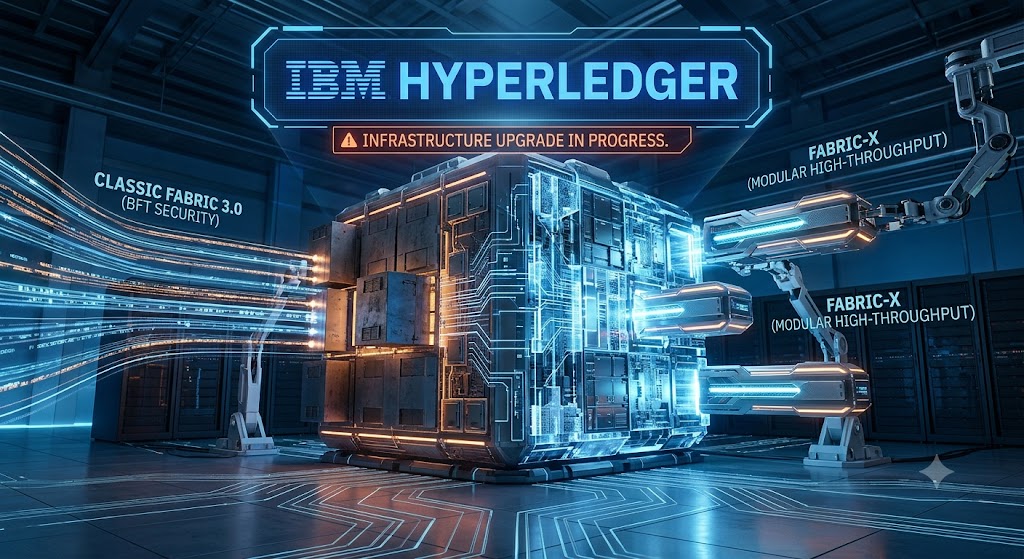
The classic Hyperledger Fabric architecture remains a dominant force for enterprise blockchain deployments. The traditional setup relies on a specific validation flow where transactions move sequentially through endorsement, ordering, validation, and finally commit.
Recent updates to this classic track include:
GetAllStatesCompositeKeyWithPagination(), also allows for the bulk retrieval of all composite keys within a chaincode.While classic Fabric is stable, demanding financial workloads expose the limits of its standard implementation. A traditional Fabric peer combines endorsement, validation, and ledger storage into a single monolithic component.
To address this, IBM Research presented Fabric-X at the SIGMOD 2026 conference. This is a clean-room implementation designed specifically to handle high-throughput regulated assets, such as central bank digital currencies (CBDCs) and tokenized money.
Fabric-X replaces the monolithic peer with microservices, separating endorser nodes, committer services, and scalable ledger storage. It also swaps out the Raft consensus mechanism for Arma BFT consensus. This unbundled architecture has been benchmarked at over 400,000 transactions per second through horizontal scaling.
The 2026 roadmap for Fabric-X includes several key features:
As of mid-2026, Fabric-X is considered a preview state, suitable for development and pilots, but not yet recommended for regulated production deployments until further security audits are completed.
For the average person or business, the updates to IBM’s Hyperledger Fabric, and specifically the creation of Fabric-X, mean that blockchain technology is moving out of the “experimental pilot” phase and becoming a reliable, invisible piece of everyday financial plumbing.
These advancements represent a shift from asking if a private blockchain can work to realizing that it can handle the speed, privacy, and volume required by global commerce. Here is how that impact takes shape.
For businesses that rely on global supply chains or international payroll, cross-border payments have historically been slow (taking days) and expensive (costing $25 to $50 per transaction due to intermediary bank fees).
The high-throughput capabilities of architectures like Fabric-X allow these payments to settle in minutes. By removing correspondent banking fees, businesses can execute international transfers at a fraction of the historical cost. This is currently one of the most heavily adopted enterprise blockchain use cases.
Global trade involves a massive paper trail of customs documents, bills of lading, and letters of credit. When data is siloed between carriers, banks, and insurers, disputes and delays are common.
Classic Hyperledger Fabric is already widely used for supply chain traceability. It replaces fragmented records with a single, shared digital ledger that all permissioned parties can verify.
Asset tokenization converts ownership rights of physical and financial assets…such as real estate, bonds, or private credit…into digital tokens on a blockchain.
The ability for Fabric-X to handle regulated, high-throughput assets like these means:
As of 2026, many central banks are exploring or piloting Central Bank Digital Currencies (CBDCs). Fabric-X was specifically designed to handle the massive transaction volume required by national-scale payment systems.
When commercial banks test tokenized deposits or CBDCs on this infrastructure, it paves the way for programmable money. Businesses will be able to build automated financial products with rules written directly into the currency (e.g., funds that can only be spent on specific types of goods or released when a specific contract milestone is met).
*****
Stand Fast, the XRP Issue, George 46 : https://georgemagazine.com/product/george-magazine-issue-46/
George’s America’s 250th: https://georgemagazine.com/product/america-250-celebrating-legacy/
Q is for Quantum Shirt: https://georgemagazine.com/product/q-is-for-quantum/
Ageless Tech E-Book Using AI to Your Advantage: https://georgemagazine.com/agelesstech/
Q is for Quantum Coffee Mug: https://georgemagazine.com/product/q-is-for-quantum-coffee-mug/
George’s Crypto E-Playbook: https://georgemagazine.com/product/the-crypto-playbook-by-george-magazine/
Aetherian Realm’s Final Judgments Map: https://georgemagazine.com/product/aetherian-realms-final-judgments-map/
America’s 250th George Magazine T-Shirt: https://georgemagazine.com/product/americas-250th-george-magazine-t-shirt/
George Dispatch Free: https://georgemagazine.com/thedispatch/
George Magazine. Print or Digital: https://georgemagazine.com/subscribe-george-magazine/
George Junior. Print or Digital: https://georgemagazine.com/subscribe-george-junior-magazine/
Project Looking Glass: https://projectlookingglass.org/
![Enjoy the [Road] Show Travel Mug with Handle, 14ozEnjoy the [Road] Show Travel Mug with Handle, 14oz](https://georgemagazine.com/wp-content/uploads/2024/08/479070202831754764_2048-300x300.jpeg)
Discount Applied Successfully!
Your savings have been added to the cart.