It was into this primitive technological landscape that Nikola Tesla dropped a conceptual bombshell. Writing for Reconstruction magazine in July of that year, the legendary inventor published an article with a title that sounded like pure science fiction: “Nikola Tesla Tells How We May Fly Eight Miles High at 1,000 Miles an Hour.”
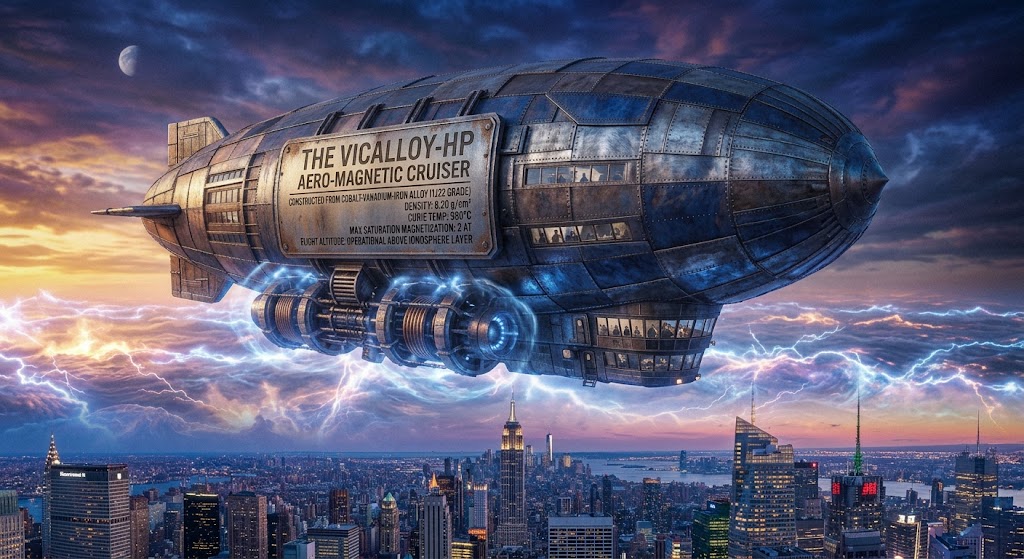
Tesla was an engineer who rarely concerned himself with incremental improvements. While other inventors were trying to squeeze a few more horsepower out of internal combustion engines or shave a few pounds off a wooden propeller, Tesla was attempting to rethink the entire paradigm of global transportation. He envisioned massive, silent, electrically powered airships tearing through the stratosphere at supersonic speeds, drawing their limitless power directly from the ambient atmosphere via ground-based wireless transmitters.
To fully grasp the sheer scale and ambition of this 1,000 MPH vision, it is necessary to unpack the three core pillars of Tesla’s aeronautical theory: the elimination of onboard fuel, the exploitation of high altitude thermodynamics, and the deployment of a global wireless energy grid.
The Tyranny of the Fuel Tank
Tesla recognized a fundamental engineering paradox that still plagues aerospace designers today. The internal combustion engine, while effective, requires a massive amount of dense, heavy liquid fuel to operate over long distances. Storing this fuel on an aircraft creates a vicious cycle of weight penalties. To fly further, a plane needs more fuel. To carry that extra fuel, the plane must be built larger and stronger, which adds weight. To lift that extra weight, the engines must be more powerful, which in turn burns more fuel.
For Tesla, the only logical solution was to sever the aircraft from its fuel source entirely.
He proposed replacing the heavy, vibration-prone internal combustion engines with lightweight, highly efficient electric motors. These motors would not be powered by massive onboard batteries, which would merely recreate the weight problem. Instead, the airships would act as giant flying receivers. Much like an electric tram draws power from an overhead wire, Tesla’s aircraft would draw their operating current from invisible waves of electromagnetic energy pulsing through the sky.
The Eight Mile High Highway
By stripping away the weight of fuel and heavy engines, Tesla solved the problem of mass. To solve the problem of speed, he turned his attention to the atmosphere itself.
Any object moving through a fluid like air encounters resistance, commonly known as aerodynamic drag. At sea level, the air is thick and heavy. Pushing a large physical object through this dense medium at high speeds requires an exponential increase in thrust. The friction generated by this effort not only slows the craft down but also generates immense heat.
Tesla’s solution was simply to climb above the problem. He correctly calculated that at an altitude of eight miles (roughly 42,000 feet), the atmospheric density drops to roughly one quarter of its density at sea level. In this rarefied environment, aerodynamic drag is drastically reduced.
With friction removed from the equation and a limitless supply of wireless electric power driving the propellers, Tesla theorized that there was virtually no limit to how fast a properly designed airship could travel. He confidently predicted regular cruising speeds of 1,000 miles per hour, allowing commercial passengers to board a craft in New York City and disembark in London a mere three hours later.
The Wardenclyffe Legacy and Wireless Power
The most fantastical element of Tesla’s vision was, of course, the power delivery mechanism. This concept did not emerge in a vacuum. It was the direct intellectual continuation of his infamous Wardenclyffe Tower project.
Earlier in the century, Tesla had secured funding from financier J.P. Morgan to build a massive transmission tower in Shoreham, New York. Tesla believed he could use the Earth and its atmosphere as a massive electrical conductor. By pumping alternating current into the ground and the sky at specific resonant frequencies, he theorized he could create standing waves of electrical energy that could be tapped into anywhere on the planet with a properly tuned receiver.
While J.P. Morgan ultimately pulled the funding when he realized there was no practical way to meter and charge customers for ambient wireless electricity, Tesla never abandoned the dream. The 1,000 MPH airships of 1919 were simply the ultimate application of the Wardenclyffe principle.
Tesla envisioned a global network of colossal power plants stationed near major cities and natural energy sources like waterfalls. These plants would beam millions of volts of high frequency energy into the upper atmosphere. The airships, equipped with specialized receiving antennae, would sweep through these energized atmospheric layers, pulling down the current required to spin their electric turbines.
A Brilliant Vision Clouded by Physics
From a modern perspective, Tesla’s 1919 article is a fascinating mix of prophetic genius and catastrophic miscalculation.
On the subject of aerodynamics, Tesla was incredibly prescient. He perfectly predicted the future of commercial aviation. Today, standard jetliners fly at exactly the altitudes Tesla recommended (35,000 to 45,000 feet) for precisely the reasons he stated: to escape the thick air of the lower atmosphere and maximize fuel efficiency through reduced drag. He was decades ahead of his time in understanding the operational benefits of the stratosphere.
Furthermore, Tesla used this same article to predict the rise of autonomous, uncrewed drones. He wrote extensively about flying machines entirely devoid of human pilots, guided and powered by remote wireless signals, predicting their use in both commercial delivery and global warfare.
However, the mechanism of wireless power transmission remains the fatal flaw in his grand design.
The physical reality of electromagnetic radiation is governed by the inverse square law. As energy radiates outward from a source, it spreads over a larger and larger area, causing its intensity to drop exponentially. To deliver the massive megawatts of power required to keep a heavily loaded commercial airship flying at 1,000 miles per hour over the middle of the Atlantic Ocean, a ground-based transmitter would have to output a truly apocalyptic amount of energy.
Attempting to beam that volume of electrical power into the sky would not create a smooth, invisible highway of energy. It would be a phenomenal disaster. The localized atmospheric heating around the transmitters would be immense. Any biological organism, whether a flock of migrating geese or the passengers aboard a lesser shielded aircraft, that inadvertently flew through the primary transmission beam would likely be subjected to a lethal, rapid roasting. It is a spectacular concept for a science fiction novel but a wildly impractical and dangerous proposition for civil engineering.
The Enduring Appeal of the Electric Sky
Despite the stark physical impossibility of his power delivery system, Nikola Tesla’s vision of the electric airship remains a captivating piece of technological history. It serves as a testament to a mind that refused to be constrained by the limitations of contemporary engineering.
When the rest of the world saw a canvas biplane struggling to cross a mountain range, Tesla looked at the exact same sky and saw a frictionless highway waiting to be exploited. He understood the fundamental physics of high altitude travel long before the materials existed to safely pressurize a cabin or cast a jet turbine.
We do not fly in giant electric zeppelins powered by invisible atmospheric beams today. We are still reliant on heavy tanks of highly refined combustible fluids. Yet, every time a modern commercial jet climbs to 40,000 feet to slip through the thin, freezing air of the upper troposphere, it is tracing the exact aerodynamic pathways mapped out by a brilliant, eccentric inventor over a century ago.
References
-
Tesla, Nikola. “Nikola Tesla Tells How We May Fly Eight Miles High at 1,000 Miles an Hour.” Reconstruction, July 1919.
-
Carlson, W. Bernard. “Tesla: Inventor of the Electrical Age.” Princeton University Press, 2013.
-
Seifer, Marc J. “Wizard: The Life and Times of Nikola Tesla.” Citadel Press, 1996.
*****
George Magazine. Print or Digital: https://georgemagazine.com/subscribe-george-magazine/
George Junior. Print or Digital: https://georgemagazine.com/subscribe-george-junior-magazine/
All George Magazine Past Issues: https://georgemagazine.com/past-george-issues/
George’s America’s 250th: https://georgemagazine.com/product/america-250-celebrating-legacy/
Ageless Tech E-Book Using AI to Your Advantage: https://georgemagazine.com/agelesstech/
George’s Crypto E-Playbook: https://georgemagazine.com/product/the-crypto-playbook-by-george-magazine/
Aetherian Realm’s Final Judgments Map: https://georgemagazine.com/product/aetherian-realms-final-judgments-map/
George Dispatch Free: https://georgemagazine.com/thedispatch/
Q is for Quantum Coffee Mug: https://georgemagazine.com/product/q-is-for-quantum-coffee-mug/
The CoVFeFe T-Shirt you want: https://georgemagazine.com/product/cov-fe-fe-george-magazine/
Q is for Quantum T-Shirt: https://georgemagazine.com/product/q-is-for-quantum/
America’s 250th George Magazine T-Shirt: https://georgemagazine.com/product/americas-250th-george-magazine-t-shirt/





![[GOOD PRESS] ON[GOOD PRESS] ON](https://georgemagazine.com/wp-content/uploads/2024/08/16389056566437433941_2048-300x300.jpeg)