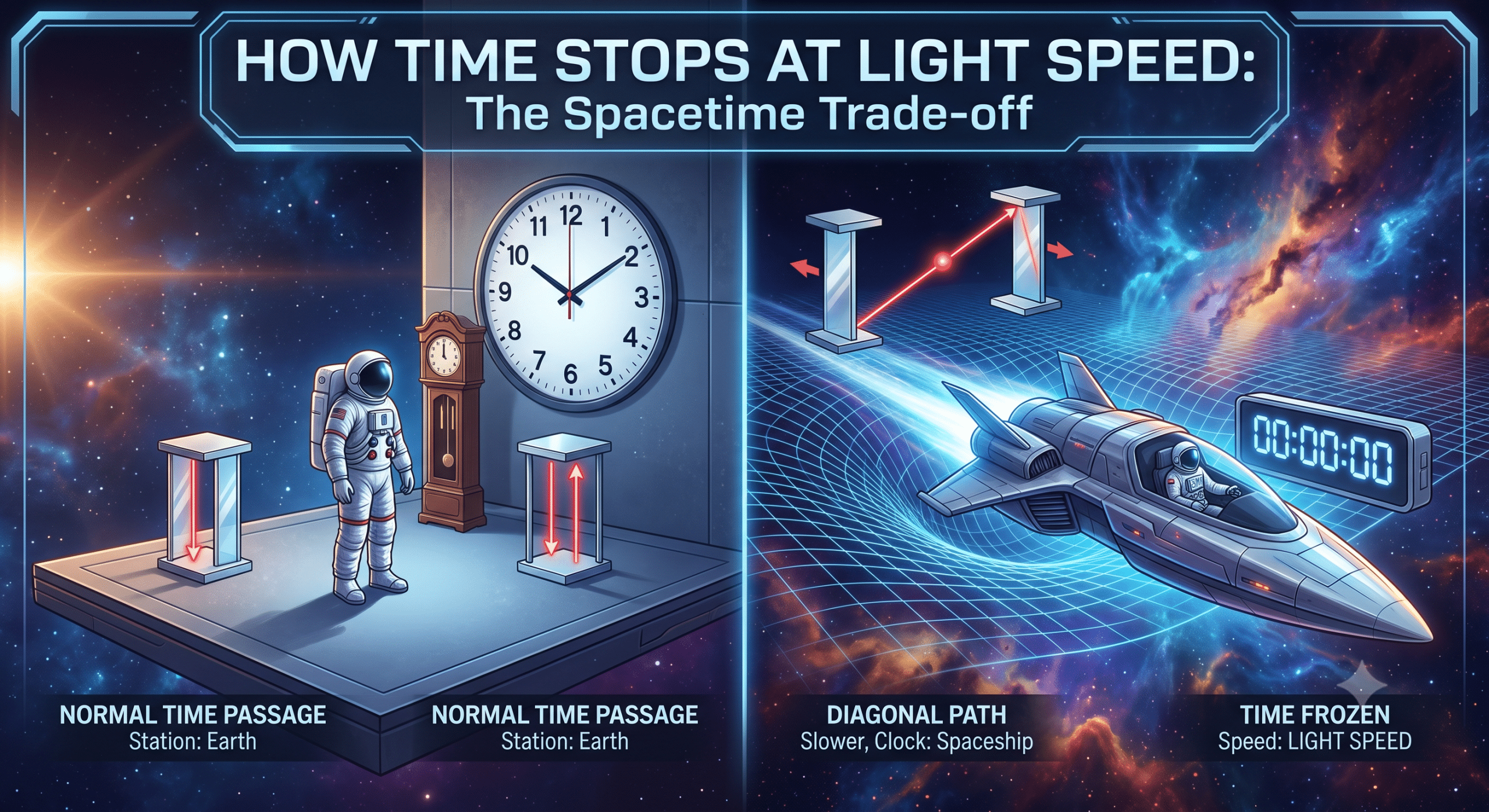
To understand why time stops at the speed of light, you have to shift how you think about speed and time. In our daily experience, we treat space and time as completely separate things. But Albert Einstein realized they are actually knitted together into a single, four-dimensional fabric called spacetime. This is just part one of this series on The Light. Coming up, we’ll discuss Tesla’s theories.
Every object in the universe is constantly moving through spacetime at exactly one total speed: the speed of light (c).
The Space-Time Trade-off
Because your total speed through spacetime is always fixed, you have to share that speed between two directions: moving through space and moving through time.
If you were able to accelerate through space to the absolute maximum limit…the speed of light…100% of your spacetime speed would be used up moving through space. There would be zero speed left over to move through time. Therefore, from the perspective of an outside observer, your time would completely stop.
The Light Clock Analogy
To see exactly why this happens mechanically, physicists use a famous thought experiment called the light clock.
Imagine a clock made of two parallel mirrors, with a single particle of light (a photon) bouncing up and down between them. Every time the photon hits the bottom mirror, the clock ticks.
-
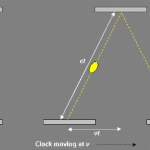
Clock in motion: If that same clock zooms past you on a spaceship, the photon doesn’t just go straight up and down from your perspective. Because the mirrors are moving forward while the photon is in transit, the photon has to travel on a longer, diagonal path to catch up with the moving mirror.
Here is the catch that makes relativity work: The speed of light is completely constant. The photon bouncing diagonally cannot speed up to cover that extra distance. Because it must cover a longer distance at the exact same speed, each bounce takes more time. To you, watching from the outside, the moving clock ticks slower.
If the clock were moving perfectly at the speed of light, the photon would just travel horizontally alongside the mirror, never catching up to the other side to bounce. The clock would never tick.
The Mathematical Proof
This stretching of time is known as time dilation, and it is governed by a mathematical equation utilizing the Lorentz factor: