Vanadium Permendur, typically an alloy of roughly 49% cobalt, 49% iron, and 2% vanadium, is prized for a unique combination of properties that make it a ‘super-material’ for specific high-performance applications. Primarily, it possesses the highest magnetic saturation of any commercially available material. This means it can maintain its strong magnetic properties even when subjected to extremely high temperatures and stress…conditions where other magnetic materials would fail or lose performance. This singular characteristic makes it vital across two seemingly disparate, but increasingly intertwined, domains.
The National Security Nexus: Power and Precision
For decades, Vanadium Permendur has been a quiet staple in the defense sector, powering subsystems that define U.S. military capability. Its highest application lies within avionics and guidance systems. Modern jet engines and missile defense systems operate under extreme thermal and mechanical loads. Vanadium Permendur cores are utilized in the high-efficiency motors, generators, and actuators that govern flight controls, navigation sensors, and weapon deployment systems. Because VP retains its peak magnetic saturation at high operating temperatures, these systems can be made smaller, lighter, and far more reliable…critical factors in aerospace engineering where every ounce and every component’s failure rate is meticulously optimized.
In the realm of advanced naval applications, particularly in submarine technology, VP plays a crucial role. Its magnetic properties are leveraged in sonar systems and specialized propulsion components. The material’s ability to minimize magnetic signature while maintaining high power density is vital for stealth technology, ensuring that U.S. vessels remain undetected while processing massive amounts of acoustic data. Furthermore, in the emerging world of hypersonic systems, where control surfaces must operate reliably under unprecedented heat and force, VP’s stability makes it one of the few viable materials for the necessary electromagnetic actuators.
The Quantum Mechanics Machine: Coherence and Stability
While VP defends the nation in the skies and seas, it is simultaneously building the future in the laboratory. Quantum computing relies on qubits…quantum bits…that operate based on the principles of superposition and entanglement. These qubits, often superconducting circuits, are incredibly delicate. Their quantum state (coherence) can be easily disrupted by the slightest environmental noise, including thermal fluctuation, vibration, and, crucially, unwanted electromagnetic radiation.
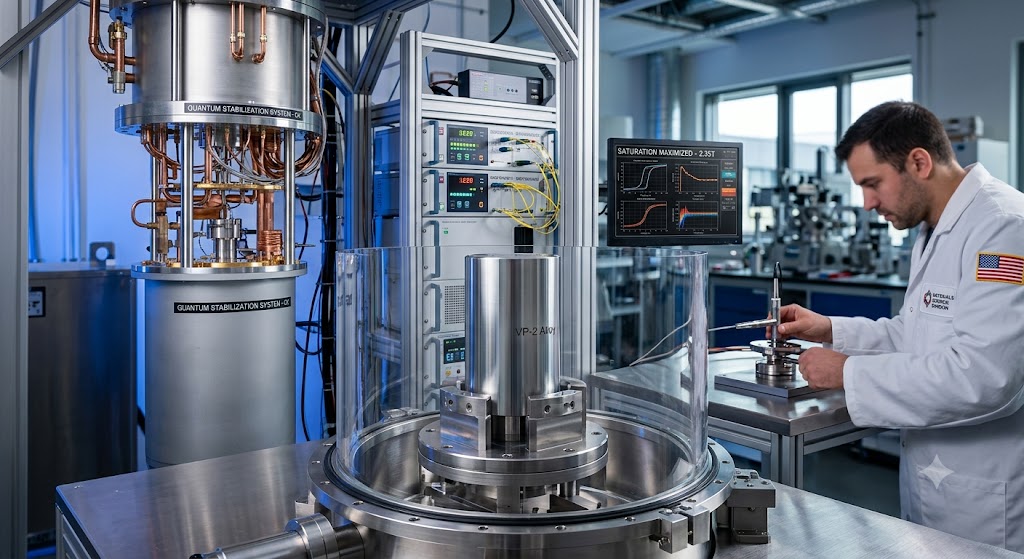
Vanadium Permendur is employed as a critical component in the complex dilution refrigerators and cryostats that house superconducting quantum processors. To maintain the qubits at near absolute zero temperatures (milliKelvin range), powerful magnetic fields must be precisely managed. VP’s high magnetic permeability and saturation allow it to be fashioned into advanced magnetic shields. These shields effectively isolate the quantum processor from the Earth’s magnetic field and other ambient electromagnetic interference, creating the ultra-quiet environment necessary for qubits to maintain coherence.
Furthermore, within the quantum mechanic’s toolkit, VP is used in highly specialized microwave components and flux biasing lines. These components control the state of individual qubits. Because VP can operate effectively in extreme cryogenic environments without introducing magnetic noise that would ‘dephase’ the qubit, it allows researchers to manipulate and read the quantum information with the necessary precision. The success of large-scale, fault-tolerant quantum computers depends heavily on engineering the control systems around the qubits, and Vanadium Permendur provides the stability that makes this engineering possible.
The Strategic Imperative
The dual utility of Vanadium Permendur highlights a growing vulnerability. The material requires high-purity cobalt and vanadium…critical minerals with complex, often unstable, global supply chains. As the United States accelerates its quantum computing initiatives (aimed at future cryptographic and logistical advantages) and concurrently modernizes its defense systems, the demand for VP will only grow.
Recognizing this strategic bottleneck, the U.S. government has prioritized securing the supply chains for these critical minerals and investing in domestic processing capabilities for alloys like VP. Ensuring a reliable supply is no longer just an industrial concern; it is a fundamental requirement for both national defense and technological leadership in the quantum age. Vanadium Permendur may be a hidden component, but its role in powering the core of American security and innovation is indisputable.
References and Citations
- U.S. Department of Energy (DOE). (n.k.). Magnetism in Extreme Environments: Basic Research Needs. Report on the Basic Research Needs Workshop.
- National Quantum Initiative Act, Pub. L. No. 115-368 (2018). (Legislation directing federal investment in quantum research).
- Asner, D. M., et al. (2018). Magnetic shielding performance of a cryogenic Permendur layer. Review of Scientific Instruments, 89(12), 123101. doi:10.1063/1.5050308 (Specific study on cryogenic application).
- Standard Specifications for Soft Magnetic Alloys (V-Co-Fe). (e.g., ASTM A801). Relevant material science standards.
- Office of the Under Secretary of Defense for Acquisition and Sustainment. (2021). Securing Defense-Critical Supply Chains. Report to the President. (Discussion on critical materials including cobalt).
- Oliver, W. D., & Welander, P. B. (2013). Materials in superconducting quantum bits. MRS Bulletin, 38(10), 816-825. (Overview of material challenges in quantum computing).
*****
Stand Fast, the XRP Issue, George 46 : https://georgemagazine.com/product/george-magazine-issue-46/
The CoVFeFe Shirt you want: https://georgemagazine.com/product/cov-fe-fe-george-magazine/
George’s America’s 250th: https://georgemagazine.com/product/america-250-celebrating-legacy/
Q is for Quantum Shirt: https://georgemagazine.com/product/q-is-for-quantum/
Ageless Tech E-Book Using AI to Your Advantage: https://georgemagazine.com/agelesstech/
Q is for Quantum Coffee Mug: https://georgemagazine.com/product/q-is-for-quantum-coffee-mug/
George’s Crypto E-Playbook: https://georgemagazine.com/product/the-crypto-playbook-by-george-magazine/
Aetherian Realm’s Final Judgments Map: https://georgemagazine.com/product/aetherian-realms-final-judgments-map/
America’s 250th George Magazine T-Shirt: https://georgemagazine.com/product/americas-250th-george-magazine-t-shirt/
George Dispatch Free: https://georgemagazine.com/thedispatch/
George Magazine. Print or Digital: https://georgemagazine.com/subscribe-george-magazine/
George Junior. Print or Digital: https://georgemagazine.com/subscribe-george-junior-magazine/



![[GOOD PRESS] ON[GOOD PRESS] ON](https://georgemagazine.com/wp-content/uploads/2024/08/16389056566437433941_2048-300x300.jpeg)