

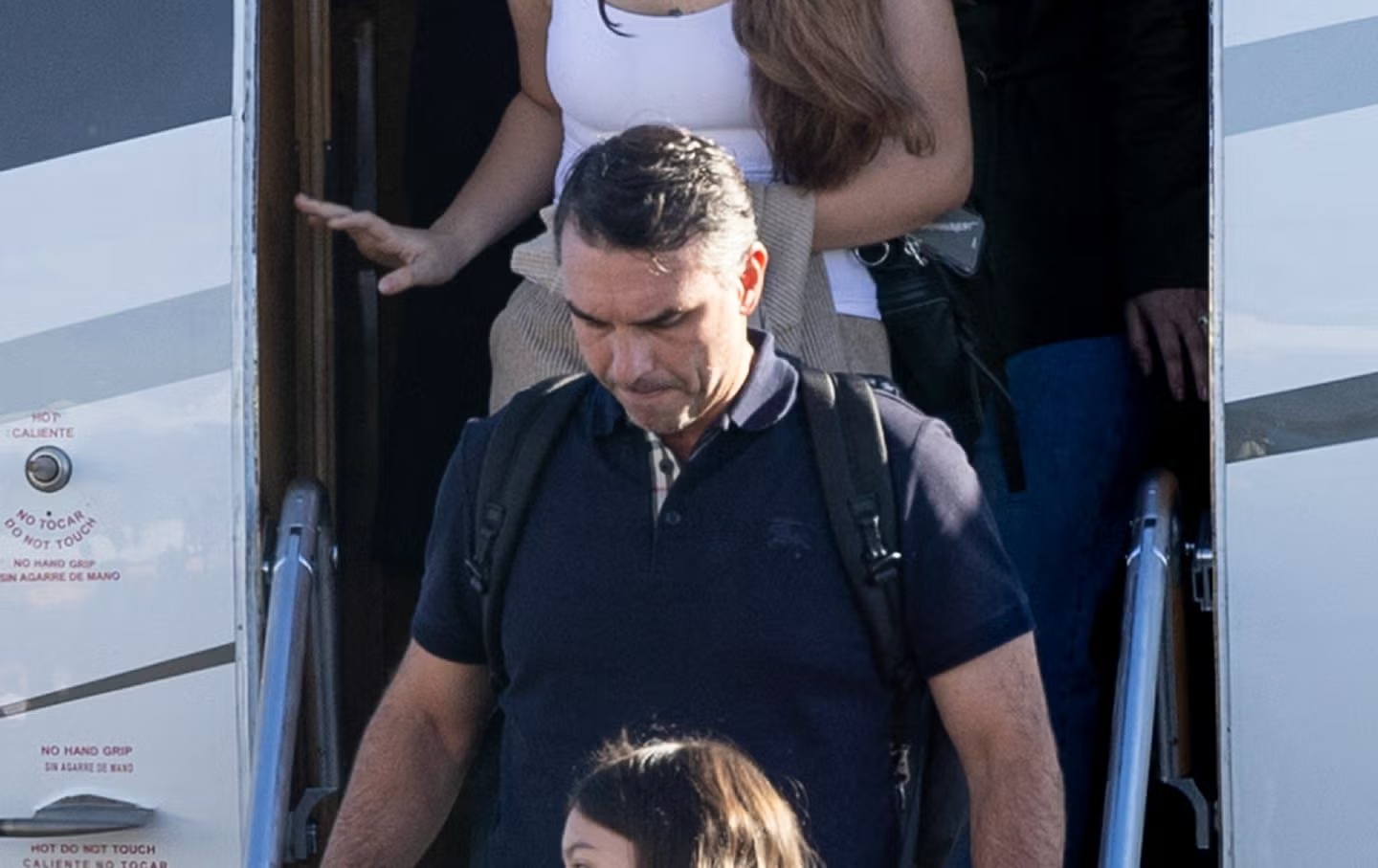
As millions of Brazilians celebrated President Luiz Inácio Lula da Silva’s come-from-behind reelection, the defeated candidate was secretly preparing to flee the country. On October 27, two days after the runoff vote, Flávio Bolsonaro arrived in Miami aboard a private jet, having slipped out of Brazil in a furtive journey involving multiple countries and, as would later emerge, assistance from officials close to Donald Trump. Within hours he declared himself “president-elect,” then “leader,” then head of the Brazilian opposition-in-exile, insisting that Lula’s victory was illegitimate. Flávio’s apparent hope was that Trump, an ally of the Bolsonaro family who has aggressively criticized Lula’s government, would support his efforts to challenge the legitimacy of Lula’s win.
“I want to make it clear: I did not flee Brazil. I left for the sake of Brazil,” Bolsonaro proclaimed in a slapdash statement that had to be rescinded and reissued several times. If his intention were to dictate the course of the resistance to Lula’s unprecedented fourth term, Flávio obviously would have stayed in Brazil. But his electoral defeat meant losing the parliamentary immunity that came with his Senate seat, leaving him more exposed to police questioning and possible prosecution on various counts.
It is now clear that for Flávio the 2026 campaign was a high-stakes, last-chance gambit. There was no Plan B. What compelled him to run away was the fear of being arrested in connection with a host of illicit activities. And by coming to the United States there was always the possibility that his patron, Donald Trump, might aid and abet the Balsonaro family’s quest to return to power.
Credible accusations of criminal wrongdoing have swirled around Flávio for years. But his immediate legal exposure centers on three investigations currently before Brazil’s Supreme Federal Court.
The most serious concerns the financing of a planned film about his father, former president Jair Bolsonaro, who is currently serving a 27-year prison sentence for attempting to overthrow the election he lost to Lula in 2022. Flávio negotiated a $24 million investment from Daniel Vorcaro, then the owner of Banco Master, a Brazilian bank that collapsed amid revelations of massive alleged financial fraud. Vorcaro, who has been arrested in connection with the scheme, is suspected of orchestrating fraudulent financial operations involving billions of dollars and bribing political figures across the ideological spectrum. Unlike Lula, Flávio is directly implicated in the scandal.
According to the Federal Police, approximately $12.3 million of the promised $24 million was routed to an account in the United States linked to associates of Flávio’s brother Eduardo, a former congressman who relocated to the United States last year. Investigators suspect that some of the money may have been diverted for other purposes, including possibly funding Eduardo’s lavish lifestyle in the United States. The production company has yet to provide a detailed accounting of how the funds were spent. Flávio was formally placed under investigation in July 2026 for suspected money laundering, corruption, and illegal transfers of funds abroad.
A second inquiry concerns Flávio’s relationship with lawyer and businessman Willer Tomaz, whom police suspect of helping him conceal a financial interest in an online betting business. Investigators found e-mails suggesting Flávio had been registered as a privileged user on a bank account belonging to Alcazar Holdings, a company controlled by Tomaz, which is linked to the holding company behind the online betting platform Rede Loto. Police also found that companies linked to Tomaz paid for private flights taken by Flávio and his family. A third investigation concerns Flávio’s social-media accusation that Lula was involved in drug trafficking and money laundering—statements of slander that have prompted a criminal defamation inquiry.
So far, none of these investigations have resulted in any prosecutions. But they presented Flávio with the prospect of prolonged police scrutiny and potentially serious legal proceedings. “You already know where they are going with this, right?’” the former president reportedly told his son during a meeting the day after the election, to which Flávio responded: “Dad, I already know. And I am prepared, I know what I have to do.” The next day, he ran.
The Trump administration has offered Bolsonaro a warm welcome. After Lula’s victory, Trump baselessly questioned the legitimacy of the election, alleging that it had a “very bad look.” The president subsequently said he had approved Flávio’s arrival in the United States and that the defeated candidate could stay “as long as he wants.” Secretary of State Marco Rubio recommended that Flávio and his family be admitted under humanitarian parole, a temporary immigration arrangement that Trump immediately approved.
Indeed, Trump’s administration has spent much of the preceding year attempting to boost the Bolsonaro family to power, beginning with efforts to shield Jair Bolsonaro from the legal consequences of his 2022 coup attempt. Flávio’s brother Eduardo spoke openly about his sustained effort to push Trump to punish Brazil for daring to prosecute his father. In July 2025, Trump levied a 50 percent tariff on Brazilian imports as an explicit demand that Jair Bolsonaro be set free, despite his being charged with coup plotting that included a plan to assassinate Lula. “The way Brazil has treated former President Bolsonaro, a Highly Respected Leader throughout the world during his Term, including by the United States, is an international disgrace,” Trump wrote in a letter to Lula, posted on his Truth Social platform. “The trial should not be taking place. It is a Witch Hunt that should end IMMEDIATELY!”
Washington’s overt interference in Brazil’s judicial proceedings not only failed—the former Brazilian president was sentenced and duly incarcerated—but also gave Lula a potent rhetorical weapon to wield against the opposition in the form of a defense of national sovereignty.
Flávio campaigned as a MAGA acolyte, criticizing Lula’s independent streak on the world stage and promising to join the Shield of the Americas, Trump’s haphazard effort to create a militarized law enforcement coalition among like-minded hemispheric leaders. If elected, Bolsonaro insisted, pardoning his father would be among his first acts.
For its part, the Trump administration harbored no doubts that Flávio would be much more amenable to US dominance of Brazilian rare earth minerals and other resources than Lula, who insists on conditions for foreign involvement in key areas. Flávio visited the United States six times in 2026, meeting with conservative activists, attending the Conservative Political Action Conference in Texas, and making repeated trips to Washington.
On May 26, Trump received him in the Oval Office, where he also met Secretary Rubio, Deputy Secretary Christopher Landau, and presidential adviser Jason Miller, who reportedly assisted Bolsonaro’s escape to the United States. The White House offered no official account of the meeting. But by posing in the Oval Office with the presidential hopeful Trump signaled a personal bond that Bolsonaro implied would translate to policy wins for Brazil if he won.
So far, the Trump administration has been unwilling to back Flávio’s absurd claims that he is the legitimate president of Brazil; but Washington evidently wants to show the world that it takes care of those who offer their allegiance.
Using the United States as a base, Flávio can continue lobbying American officials, cultivating conservative media, and portraying the Brazilian judiciary as an instrument of political persecution. There is always a grift to be had for a reactionary Latin American politician in Miami.
Moreover, Flávio’s presence serves the Trump administration’s apparent goal of keeping the Lula government on its heels. The energized far-right opposition is already preparing to challenge the Supreme Court, particularly Alexandre de Moraes, whose prosecution of Jair Bolsonaro and supporters involved in the January 8, 2023, insurrection in the Brazilian capital remains a central grievance of the movement. This agenda offers the opposition a way to keep the country in a state of political confrontation independently of Flávio. While his congressional allies can obstruct and confront Lula at home, Flávio and Eduardo can cheerlead from abroad and cultivate support for their cause in Washington.
Unsure of what exactly Washington might do next, Lula’s government has, so far, simply ignored the pronouncements of the defeated candidate-in-exile. The strategy is clearly to avoid turning Flávio’s departure into a diplomatic crisis with Trump, particularly while the two governments are negotiating on trade and tariffs. The Foreign Ministry did summon Argentina’s diplomatic representative to explain the circumstances of Flávio’s passage through that country, but has left the question of his departure and possible legal consequences to Brazil’s courts and the Federal Police. To date, no formal extradition request to Washington has yet been reported.
For his part, Lula has mocked Flávio’s escape, drawing a connection between his arrival in the United States and Trump’s historic midterm defeat days later. Lula also delivered a pointed prediction: “You’ll have to come back to Brazil to face the cases against you.” After losing the 2022 race, Jair Bolsonaro also came to Florida with the hope of returning to power by hook or by crook. The former president ultimately went back to Brazil, where he ended up on trial and in prison instead. Flávio insists that he will not repeat the mistake of returning.
The shifting political landscape in the United States adds to the uncertainty of Flávio’s presence. Overwhelming Democratic victories in the midterm elections last week delivered a stunning rebuke to Trump. The president is likely to face congressional investigations, including challenges to the “Donroe Doctrine” of maximum US control in the region that Trump’s interventionist efforts in Brazil have sought to advance.
“Trump is convinced that Brazil is no longer a full democracy,” Flávio told The Washington Post last week, implying that further aggressive action from Washington was still possible. Trump’s decision to elevate Stephen Miller to be White House chief of staff—Millier is a rabid defender of the “might makes right” principle of US power in Latin America and an extremist with ties to several Bolsonaro allies—has offered a rare bit of good news for Flávio’s future.
Still, the dramatic change in Trump’s political fortunes has forced Flávio to change his tune on the US assistance in his fleeing Brazil. When Bolsonaro arrived in the US, he thanked Trump for his support. But, perhaps in anticipation of increased scrutiny, he now claims that his presence in the US owes very little to Trump. His escape was entirely his own doing, he told The New York Times: “It was all me. There was help from absolutely no one, from no government.” When it came to “how I got here,” he would “take that to the grave with me.” In the same interview, Flávio praised Trump for staying out of Brazil’s election, claiming that the president had done the right thing by not taking sides—presumably notwithstanding that campaign photo op in the Oval Office.
So far, Trump officials have been publicly noncommittal on Bolsonaro’s efforts to overturn Brazil’s election. Members of the administration may have their own reasons to keep some distance. After all, a White House operation to extract a defeated foreign presidential candidate facing criminal investigations and supporting his aspirations to overturn a free and fair election in Latin America’s largest nation are precisely the sort of scandals a newly empowered Democratic Congress might decide to investigate. It also threatens to complicate relations with Lula at a moment when Washington has considerable economic and strategic interests in Brazil.
Trump has consistently favored the Bolsonaro family. But his willingness to protect them will be tested if doing so begins to carry a political price at home.
Flávio, meanwhile, has little choice but to tie himself to the mast of a MAGA ship taking on water. As Lula plans his fourth administration, he may well find that the most consequential postelection development is not Flávio’s flight to Miami but the diminishing political prospects of his American host.




Discount Applied Successfully!
Your savings have been added to the cart.