1. The Core Causes
• Severe Housing Shortage (the #1 driver)
The U.S. is short an estimated 3.5–5.5 million homes, depending on the source. Builders under‑built for more than a decade after the 2008 crash, and zoning restrictions in major metros choke supply. This shortage alone keeps prices elevated even when demand cools.
• Mortgage Rate Shock
Rates jumped from 2.7% to 7–8% in two years…the fastest increase in modern history. This didn’t crash prices because it froze supply:
- 92% of homeowners have mortgages under 5%.
- They refuse to sell and give up their low rate.
This “lock‑in effect” created the lowest inventory in 40 years.
• Institutional Buyers & Cash Dominance
Wall Street firms, private equity, and cash investors now represent 25–33% of purchases in some markets. They don’t care about mortgage rates, which keeps competition high for the limited homes available.
• Demographic Pressure
Millennials…the largest generation…are in peak home‑buying age. Demand is structurally strong even when affordability is weak.
• Construction Costs & Labor Shortages
Materials, land, and labor costs remain elevated. Builders can’t profitably produce “starter homes,” so they focus on higher‑margin properties, worsening the affordability crisis.
2. So Is It a Bubble?
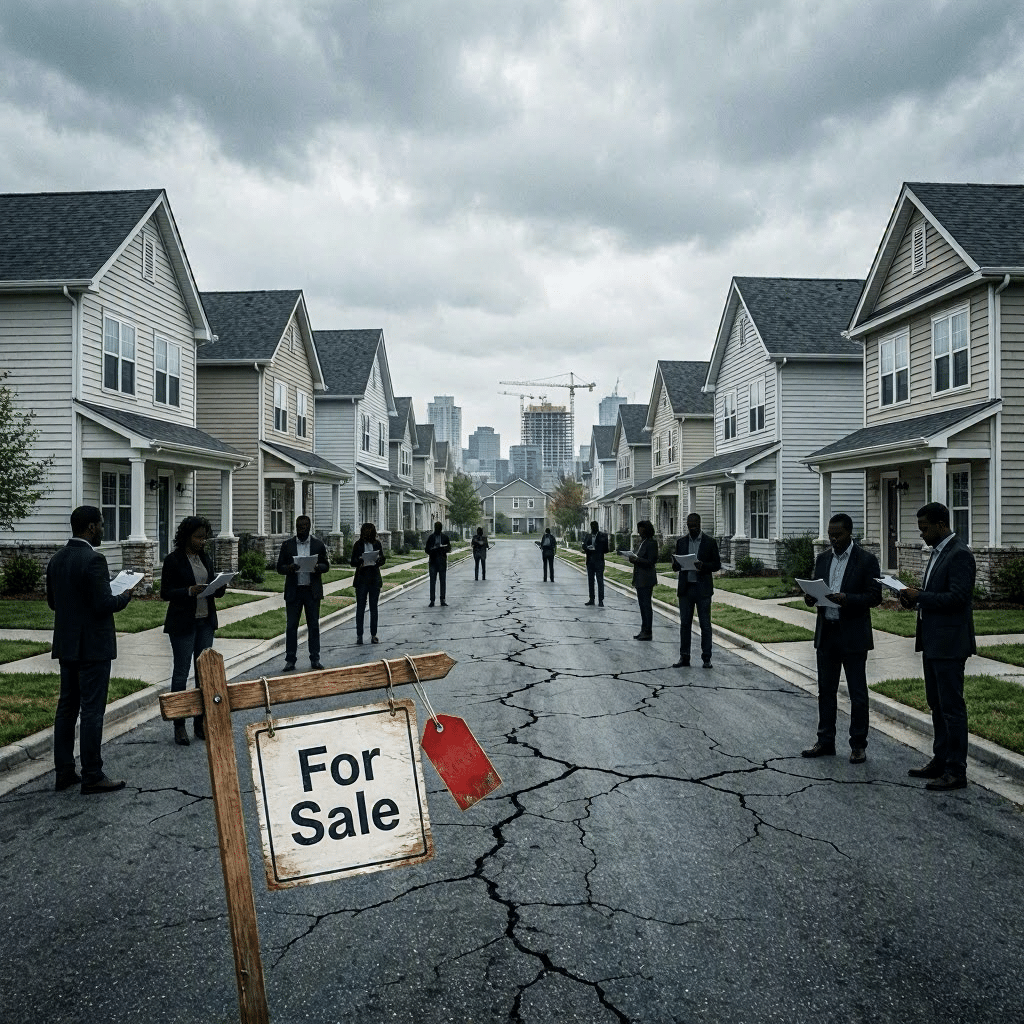
Not in the traditional sense. Prices are high because supply is broken, not because of reckless lending or speculative flipping. Unlike 2008:
- Credit standards are tight.
- Subprime lending is minimal.
- Homeowners have record equity.
- Delinquencies remain historically low.
This is a housing affordability crisis, not a speculative bubble.
3. What Could Cause a Correction?
A meaningful price decline would require one of the following:
- A surge in unemployment
- A wave of forced selling
- A major increase in housing supply
- A rapid drop in investor demand
- A credit crunch
None of these are happening at scale today.
4. How This Ultimately Resolves
• Gradual Price Softening, Not a Crash
Most economists expect sideways-to-slightly-down prices over several years, not a collapse.
• Mortgage Rates Slowly Normalize
If rates drift back toward 5%, demand will rise…but so will supply as locked‑in owners finally move.
• Policy & Zoning Reform
Some states are already legalizing duplexes, ADUs, and higher-density zoning. This is slow but necessary.
• Build-to-Rent Expansion
Institutional builders will continue producing rental communities, increasing supply indirectly.
• Long-Term: Supply Catch-Up
The market stabilizes only when construction finally meets demographic demand…a process that may take 5–10 years.
*****
Get “Co V Fe Fe” Shirt here: https://georgemagazine.com/product/cov-fe-fe-george-magazine/
Get the Aetherian Realm’s Final Judgments Map: https://georgemagazine.com/product/aetherian-realms-final-judgments-map/
Get Ageless Tech. Using AI to Your Advantage: https://georgemagazine.com/agelesstech/
Get George’s America’s 250th: https://georgemagazine.com/product/america-250-celebrating-legacy/
Get America’s 250th George Magazine T-Shirt: https://georgemagazine.com/product/americas-250th-george-magazine-t-shirt/
Get The George Dispatch: https://georgemagazine.com/thedispatch/
Get George Magazine. Print or Digital: https://georgemagazine.com/subscribe-george-magazine/
Get George Junior. Print or Digital: https://georgemagazine.com/subscribe-george-junior-magazine/
Get George’s Crypto E-Playbook: https://georgemagazine.com/product/the-crypto-playbook-by-george-magazine/
Visit Project Looking Glass: https://projectlookingglass.org/




![Enjoy the [Road] Show Travel Mug with Handle, 14ozEnjoy the [Road] Show Travel Mug with Handle, 14oz](https://georgemagazine.com/wp-content/uploads/2024/08/479070202831754764_2048-300x300.jpeg)