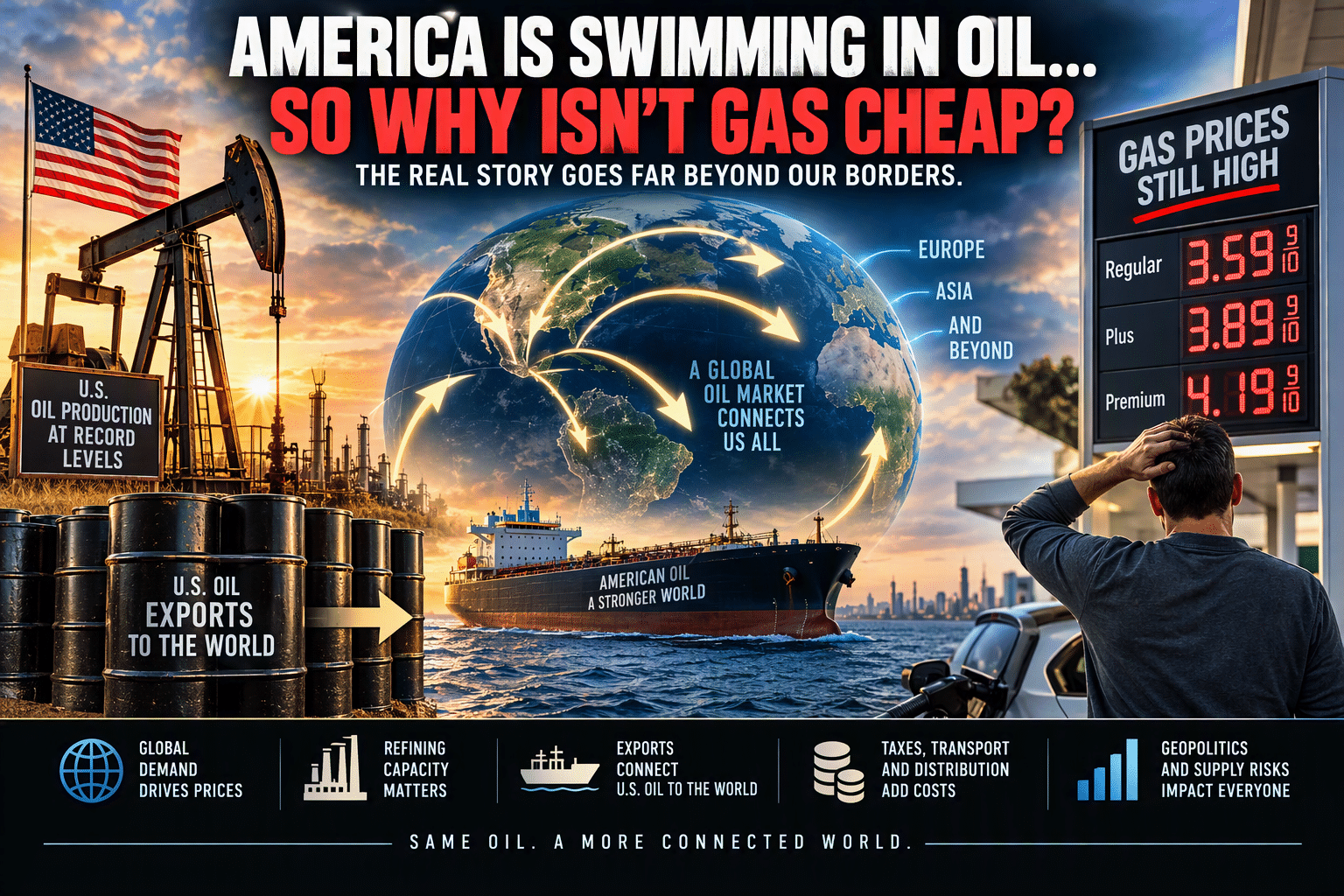
America Doesn’t Have Its Own Oil Market
Once American crude oil enters the commercial marketplace, its value is influenced by what buyers are willing to pay for comparable oil elsewhere. Major benchmarks such as West Texas Intermediate and Brent provide reference prices for crude bought and sold in interconnected markets.
That means an oil producer in Texas isn’t economically isolated from buyers in Europe or Asia. If an overseas refinery is willing to pay a competitive price for American crude, the producer has an incentive to sell into that market instead of offering the same oil to an American refinery at a substantially lower price.
Exports therefore help connect American oil supplies with international demand.
This also explains something that initially seems contradictory: America can simultaneously be an enormous oil producer, an exporter and a country exposed to high world oil prices.
Current U.S. Energy Information Administration data illustrate that connection. On October 14, 2026, WTI crude was $101.91 per barrel while Brent was $126.55. Production at home clearly doesn’t make American crude immune from events affecting international petroleum markets.
Then Why Export the Oil?
Because not every barrel of crude oil is identical. Different varieties have different densities, sulfur contents and other characteristics, and refineries are designed around particular combinations of crude oil and processing equipment. Consequently, the most economically attractive destination for a barrel isn’t necessarily the refinery closest to the well that produced it.
The American petroleum system can therefore export certain crude oils while importing other crude oils or petroleum products. This isn’t necessarily evidence of a shortage. It reflects companies optimizing an enormous network of wells, pipelines, refineries, ports and international customers.
The United States becoming a net petroleum exporter represented a major change in America’s position in the global energy system. But being a net exporter doesn’t mean withdrawing from that system. In many respects, it means becoming an even larger participant in it.
More American Oil Still Matters
This doesn’t mean American production is irrelevant to prices. Quite the opposite. Adding American barrels increases the world’s available supply. All else being equal, additional supply puts downward pressure on prices compared with a world in which those barrels were never produced. American production can therefore help restrain global prices without necessarily creating a completely separate, bargain-priced domestic market.
Think of it this way: America’s enormous agricultural output doesn’t mean American farmers will voluntarily sell internationally traded crops domestically for half of what buyers elsewhere will pay. Oil producers face essentially the same economic incentive.
And during an international supply disruption, American production becomes particularly valuable because it provides additional supply outside the affected region.
Gasoline Adds Another Layer
The price consumers pay at a gasoline station isn’t simply the price of crude oil divided into gallons. Crude must be transported, refined into gasoline, distributed through terminals and pipelines, delivered to filling stations and sold at retail. Refinery economics, inventories, transportation constraints and taxes all affect what ultimately appears on the pump. That’s why gasoline prices can behave differently among states and regions even when those areas are exposed to essentially the same crude-oil market.
The Real Advantage of Producing Oil
This brings us to an important distinction. Energy abundance does not mean price isolation.
Producing huge amounts of oil gives the United States greater economic and energy flexibility and reduces dependence on foreign supply relative to what dependence would otherwise be. But it does not construct an economic wall around American petroleum.
As long as American producers can participate in international trade, the price of their product will remain connected to what that product is worth in the broader marketplace.
So when international supplies tighten, geopolitical events threaten production, transportation becomes more expensive or worldwide demand exceeds available supply, Americans feel the effects too. The International Energy Agency’s October 2026 report, for example, describes how international supply disruption, crude costs, freight costs, inventories and product availability are interacting across the current market. That leads to the seemingly paradoxical reality:
The United States can pump extraordinary quantities of oil, export millions of barrels, and still experience high oil prices at home. America doesn’t simply pay an “American price” for oil. We participate in, and largely pay, the world price.
*****
George Magazine 2027 Calendar: Messiah’s Narrative-Celestial Revelation. ONLY 1776 Available: https://georgemagazine.com/product/george-magazine-2027-calendar/
George Magazine Print or Digital: https://georgemagazine.com/subscribe-george-magazine/
George Junior Magazine Print or Digital: https://georgemagazine.com/subscribe-george-junior-magazine/
Get paid! Get George’s A.I. Paycheck, and start earning now! https://georgemagazine.com/ai-paycheck/
Ageless Tech E-Book Using AI to Your Advantage: https://georgemagazine.com/agelesstech/
George’s Crypto E-Playbook: https://georgemagazine.com/product/the-crypto-playbook-by-george-magazine/
Aetherian Realm’s Final Judgments Map: https://georgemagazine.com/product/aetherian-realms-final-judgments-map/
George’s America’s 250th: https://georgemagazine.com/product/america-250-celebrating-legacy/
America’s 250th George Magazine T-Shirt: https://georgemagazine.com/product/americas-250th-george-magazine-t-shirt/
George Dispatch Free: https://georgemagazine.com/thedispatch/
Project Looking Glass: https://projectlookingglass.org/