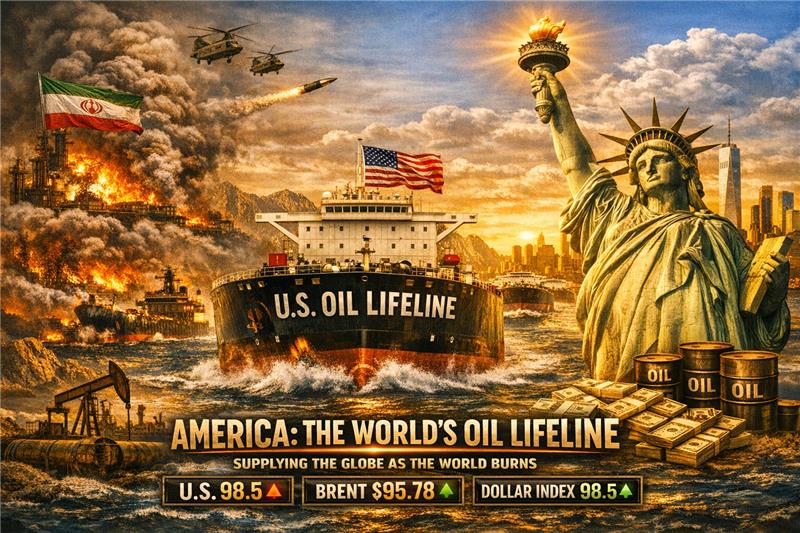
• Europe has become the largest buyer, replacing Middle Eastern and Russian barrels with U.S. light sweet crude that can be shipped safely across the Atlantic.
• China and broader Asia are buying tactically…taking U.S. cargoes when freight and spreads make sense, while continuing to absorb discounted Russian and regional grades.
This shift marks a temporary and maybe permanent but profound realignment: the Middle East’s export dominance is fractured, and the U.S. has become the stabilizing anchor of seaborne supply.
Economic impact at home
The surge in exports is boosting the U.S. economy despite high domestic fuel prices.
• Energy producers and midstream operators are reporting record cash flow.
• Gulf Coast infrastructure investment is accelerating…pipelines, terminals, and shipping capacity expansions are underway.
• The trade balance is improving as crude and refined-product exports offset imports in other categories.
These gains ripple through employment, tax receipts, and industrial activity, even as consumers face elevated pump prices.
Dollar strength and cross-market dynamics
The Dollar Index near 98.5 reflects global risk aversion. Normally, a strong dollar would pressure commodities, but the physical tightness and war premium are overriding that effect. For Europe and emerging markets, the combination of a firm dollar and $90-plus oil is a double squeeze…energy costs rise in local currencies while financial conditions tighten.
Brent’s premium to WTI (about $5) underscores seaborne tightness and direct exposure to Middle East risk. Time spreads remain in backwardation, signaling that prompt barrels still command a premium…classic tight-market behavior consistent with record U.S. exports.
What to expect in today’s trading
With WTI around $91–92 and Brent near $96, expect a headline-sensitive, range-bound session.
• Any sign of de-escalation or maritime security progress could ease prices slightly.
• Any new attack or escalation could push Brent back toward $100 and widen the spread, reinforcing demand for U.S. barrels.
• U.S. energy equities and shipping names should remain supported, while fuel-intensive sectors may lag under the weight of high energy costs and a firm dollar.
In short: America’s oil exports are powering the global market through crisis, the Middle East remains constrained by conflict, and the dollar’s strength continues to shape who can afford to chase barrels. The U.S. is not just exporting crude…it’s exporting stability.
*****
Get Ageless Tech A.I.-Using AI to Your Advantage:
https://georgemagazine.com/agelesstech/
Get George’s America’s 250th:
https://georgemagazine.com/product/america-250-celebrating-legacy/
Get The George Dispatch:
https://georgemagazine.com/thedispatch/
Get George Magazine. Print or Digital:
https://georgemagazine.com/subscribe-george-magazine/
Get George Junior. Print or Digital:
https://georgemagazine.com/subscribe-george-junior-magazine/
Get George’s Crypto E-Playbook:
https://georgemagazine.com/product/the-crypto-playbook-by-george-magazine/